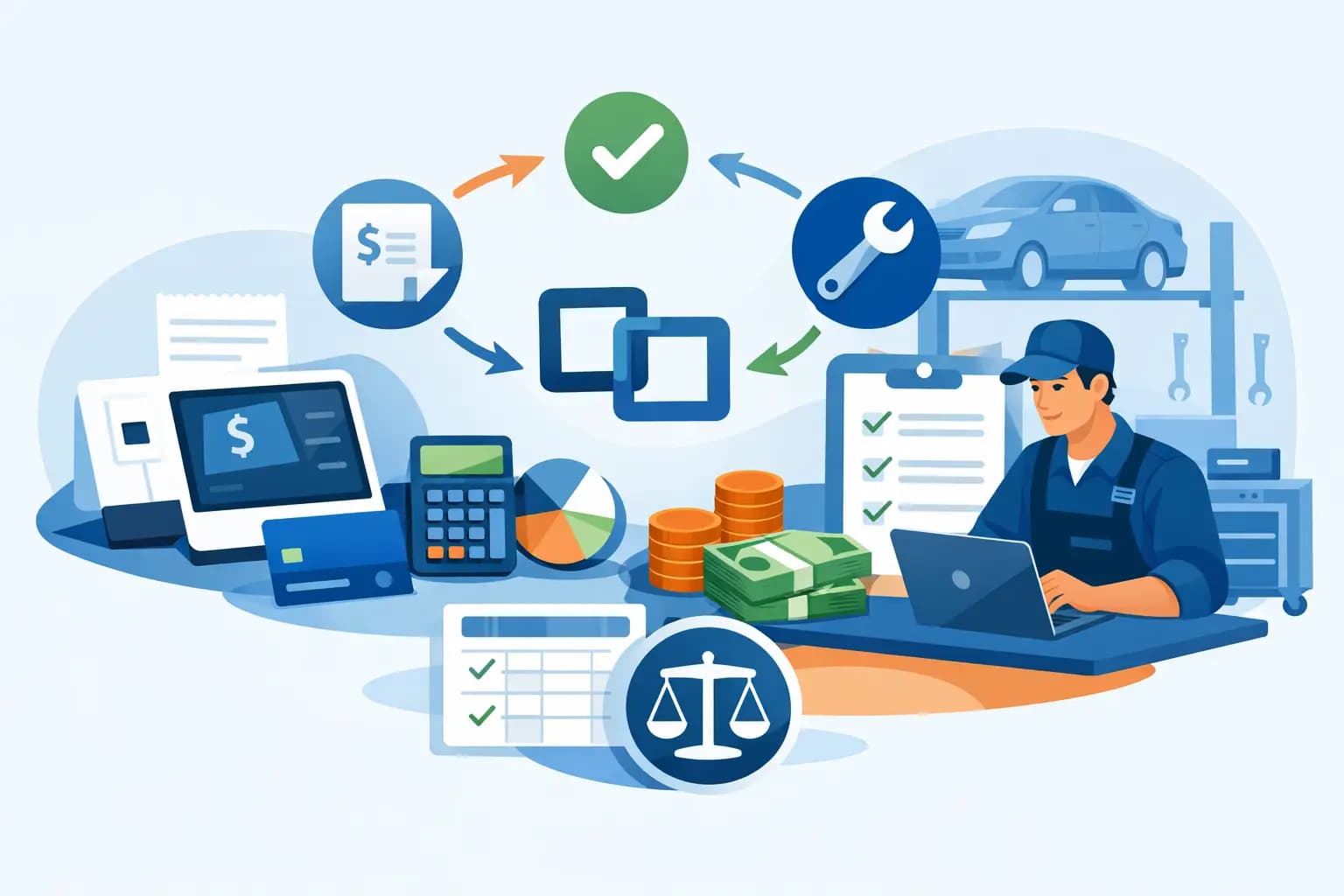
Repair Shop Payment Reconciliation That Works
Repair shop payment reconciliation gets easier when tickets, deposits, invoices, and payouts live in one workflow built for service businesses.

A repair ticket closes, the customer pays, and the day feels done - until someone has to match that payment back to the right invoice, the right technician work, the right parts, and the actual processor payout. That is where repair shop payment reconciliation usually breaks down. Not at the register, but in the gap between what happened at the counter and what shows up in the bank.
For repair businesses, reconciliation is not just bookkeeping cleanup. It is how you catch missing deposits, duplicate charges, open invoices that should be closed, and parts revenue that never got tied back to a completed job. If your shop runs on a mix of card terminals, handwritten notes, spreadsheets, text approvals, and a separate POS, the problem is not your staff. The problem is the workflow.
Why repair shop payment reconciliation is harder than retail
A standard retail sale is simple. One cart, one payment, one receipt. Most repair shops do not work like that.
A single repair can involve an intake deposit, a revised estimate, an insurance payment, a balance due at pickup, and maybe a refund if the repair changes course. That ticket may stay open for days or weeks while parts are ordered and technicians update status. If your payment records live in one place and your repair records live somewhere else, reconciliation turns into detective work.
That is why generic POS systems often create more work for service businesses. They are built to close sales fast, not to track the life of a repair job. They do not naturally account for ticket stages, device history, labor changes, warranty follow-up, or split payment timing. The more your shop grows, the more those gaps show up in cash flow reporting and end-of-day accuracy.
What clean reconciliation actually looks like
Good reconciliation is not just matching yesterday's card total to a processor report. In a repair environment, it means every payment can be traced to a specific ticket, invoice, and customer action without extra guesswork.
That includes deposits being attached to open repairs instead of sitting in a generic payment bucket. It means final pickup payments close the correct balance. It means refunded transactions have a visible reason tied to the job record. It means processor fees and payout timing are understood, so your accounting team is not chasing differences that are normal settlement delays.
When the process is clean, a manager can answer basic questions quickly. Which completed tickets are still unpaid? Which payments were collected but not tied to closed invoices? Do today's parts sales and labor sales match the jobs that actually moved through the shop? If those questions take an hour and three systems to answer, reconciliation is already costing you money.
Where shops lose control
Most reconciliation issues start upstream. The payment mismatch you find on Friday usually came from a weak intake or checkout process on Tuesday.
One common problem is collecting money outside the ticket. A front-desk employee runs a card on a standalone terminal, writes approved on the work order, and plans to update the software later. Later does not happen, or it happens with the wrong amount. Now the processor shows revenue, but the repair record does not.
Another issue is partial payments without structure. Deposits are common in repair, especially for special-order parts or high-value jobs. But if the system does not clearly show deposit collected, balance remaining, and payment status by ticket, staff will improvise. Some will mark the ticket paid too early. Others will leave it open even after pickup. Both create reporting noise.
Refunds and rework add another layer. If a customer is charged before a part arrives, or a repair is reversed under warranty, the financial side needs to stay tied to the operational side. Otherwise, the shop ends up with revenue reports that look fine on paper but do not reflect what really happened on the bench.
A better workflow for repair shop payment reconciliation
The fix is not adding another spreadsheet. It is running payments inside the same workflow as intake, estimates, invoices, and ticket status.
Start at customer intake. Every repair should begin with a ticket that can hold the full financial history of the job. If a deposit is collected, it should post directly to that ticket. If the estimate changes after diagnosis, the new amount should update the invoice without forcing staff to create side notes or manual offsets.
At approval, the system should record who approved the work, what was approved, and what financial commitment was made. This matters because many payment issues are really approval issues in disguise. If a customer disputes a charge, the shop needs a clean chain from estimate to payment to completion.
At pickup, staff should be able to see the remaining balance immediately, collect it from the same screen, and close the ticket without bouncing between systems. That single step removes a surprising amount of reconciliation friction. The fewer manual handoffs between ticket management and payment collection, the fewer errors survive into your daily close.
Why processor payouts confuse even organized shops
Even well-run shops get tripped up by payout timing. A card charge captured today does not always land in the bank today. Stripe, Square, and Clover may bundle transactions, hold reserves, deduct fees, or settle on different timelines depending on payment method and risk checks.
That means reconciliation should not rely on bank deposits alone. If your team tries to match every day of ticket revenue directly to the same day's bank activity, you will constantly think something is wrong when it is just unsettled processing. What you need is a clear view of gross payments, refunds, fees, and net payouts, all tied back to ticket-level activity.
This is where a repair-specific system earns its keep. Instead of treating card processing as a separate back-office task, it connects processor data to the jobs that generated the revenue. You are not just seeing a payout number. You are seeing which repairs created it.
The operational payoff of getting this right
Better reconciliation improves more than accounting. It tightens the whole shop.
Front-desk staff stop wasting time checking whether a customer already paid a deposit. Technicians do not have to chase approval confusion before starting work. Managers can trust end-of-day sales reporting because labor, parts, and collected payments are aligned. Owners get a cleaner view of cash flow and fewer unpleasant surprises at month end.
It also improves accountability. If a payment is missing, you can see whether it was never collected, collected outside the system, refunded, or left unmatched to an invoice. That is a very different situation from simply knowing the numbers do not tie out.
For growing shops, this matters even more. Manual reconciliation can limp along when one owner oversees everything. It falls apart when you have multiple counter staff, several technicians, and a steady stream of open tickets. Growth exposes every weak handoff.
What to look for in your system
If you are evaluating your current setup, focus less on whether it can accept payments and more on whether it can explain them.
A useful system should show payment activity inside the repair record, support deposits and partial balances, connect invoice updates to approvals, and make refunds visible in context. It should also help reconcile Stripe, Square, or Clover activity without forcing someone to export data into a spreadsheet every day. Those are not luxury features for a repair shop. They are the controls that keep revenue accurate.
Benchry is built around that reality. The goal is not to bolt payments onto a retail workflow. It is to keep intake, ticket progress, parts, invoices, and reconciliation connected so the shop can move faster without losing financial control.
Repair businesses do not need more software tabs. They need fewer gaps between what happened at the counter, what happened on the bench, and what got paid. When those records stay connected, reconciliation stops being a nightly headache and starts doing what it should have done all along - giving you a clear picture of how the shop is actually performing.